Fast Fourier Transform (FFT)
Signal Processing, Frequency Domains, and Efficient Algorithms
Analyzing Data
Given some data, we often need to ask:
- What is the nature of the data?
- What is the period?
- Can we rid the data of noise?
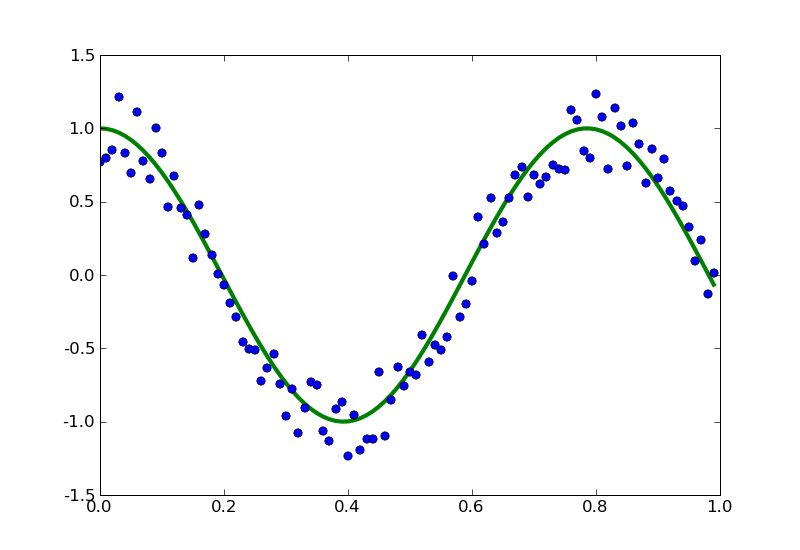
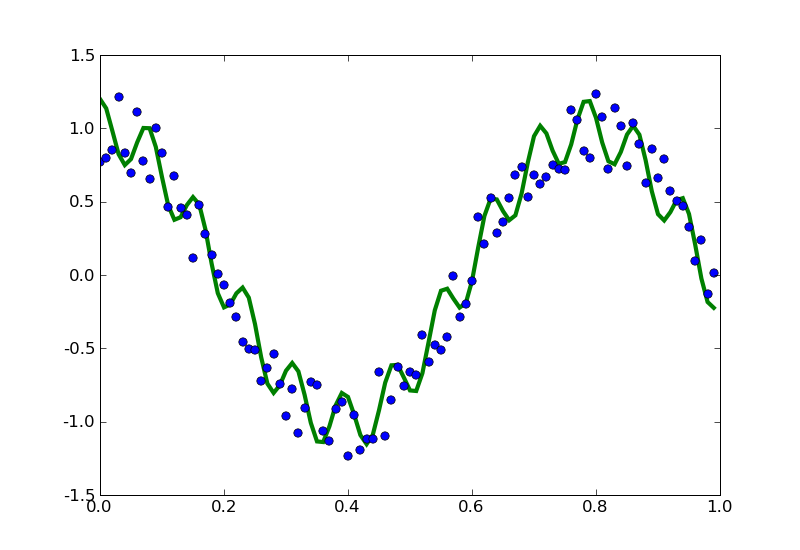
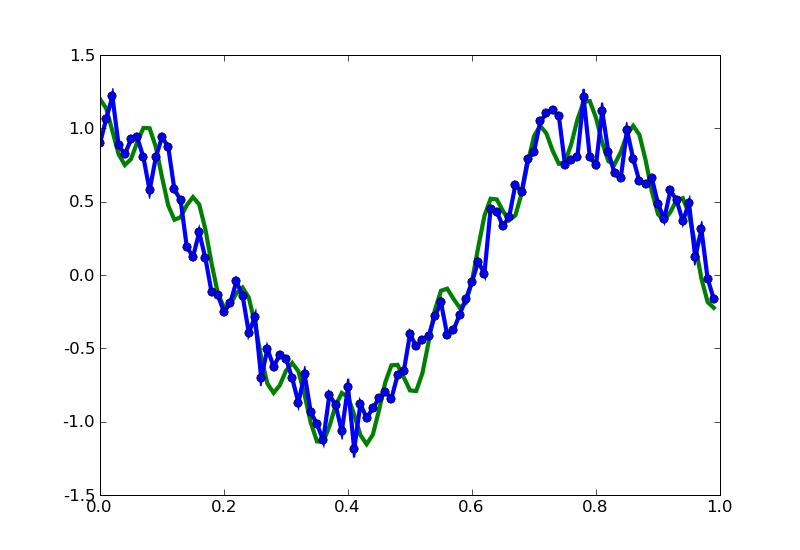
Real-World Examples
Signal Processing
Remove (high-frequency) noise in an input signal.
Weather Data
Data often contains different cycles:
- Daily data
- Yearly data
- Goal: Isolate one of these.
Economics
Seasonal adjustment: remove unwanted periodicities to reveal "secular" trends.
Audio
Digital filtering in audio.
Convolution & Correlation
Discrete convolution of two sequences of data $u$ and $v$ of length $n$:
This relates to cross correlation of two sequences or autocorrelation with self.
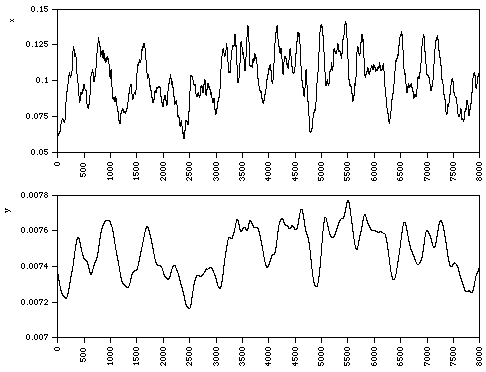
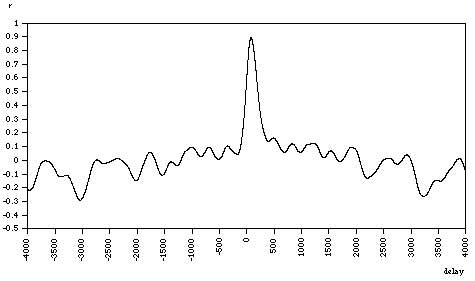
Image Registration
Aligning a sub-image with another image.


Other Applications
- Spectral Analysis
- Data compression
- Partial Differential Equations
- Multiplication of polynomials
Interpolation by Trigonometry
- When we have periodic data, use periodic interpolating functions: sines, cosines, etc.
- Decompose a function into a combination of sines and cosines (as we did with polynomial basis functions).
- Decomposing into (co)sines of different "frequencies" naturally orders the data.
- The gist: working in a frequency (transformed) space is easier (faster) than the time domain.
Recall Fourier Series
Suppose $f(x)$ is periodic on $[-\pi,\pi]$. The Fourier Series for $f(x)$ is:
$$ f(x) \approx \frac{a_0}{2} + \sum_{n=1}^{\infty} a_n \cos(nx) + b_n \sin(nx) $$with coefficients:
$$ a_n = \frac{1}{\pi} \int_{-\pi}^{\pi} f(x) \cos(nx)\, dx \quad b_n = \frac{1}{\pi} \int_{-\pi}^{\pi} f(x) \sin(nx)\, dx $$Example: Sawtooth Wave
$f(x) = x$ on $[-\pi,\pi]$.
Then $a_n = 0$ (odd function) and $b_n = 2 \frac{(-1)^{n+1}}{n}$.
$$ f(x) = 2\sum_{n=1}^{\infty} \frac{(-1)^{n+1}}{n} \sin(nx) $$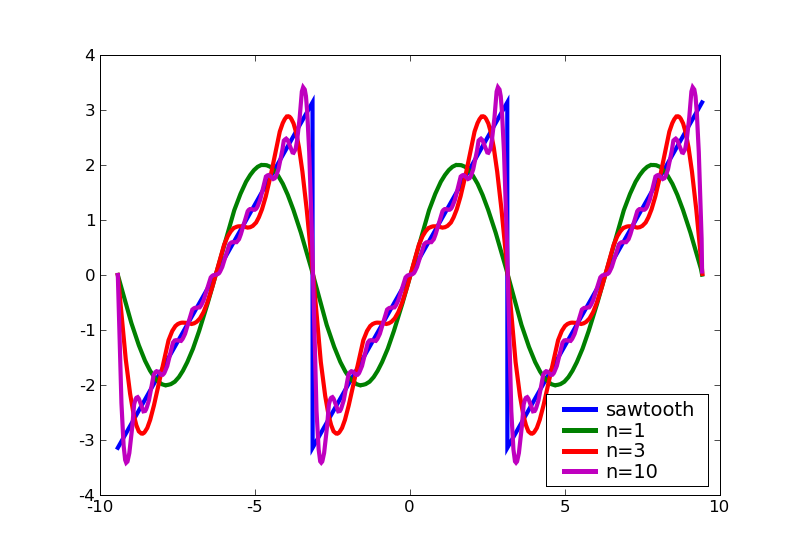
General Fourier Notation
Use complex exponential notation using Euler's Identity:
Pure cosine and sine can be written as:
$$ \cos(x) = \frac{e^{i x} + e^{-ix}}{2},\quad \sin(x) = \frac{e^{i x} - e^{-ix}}{2i} $$Then a Fourier Series on interval $[a,b]$ with period $\tau$ is:
$$ g(x) = \sum_{n=-\infty}^{\infty} G_n e^{i 2 \pi n x / \tau} $$with:
$$ G_n = \frac{1}{\tau} \int_{a}^{b} g(x) e^{-i 2\pi n x / \tau}\, dx $$Roots of Unity
A primitive $n^{th}$ root of unity for integer $n$ is given by:
The $n^{th}$ roots of unity are called twiddle factors here and are given by $\omega_n^k$ or $\omega_n^{-k}$, $k=0,\dots,n-1$.
The Discrete Fourier Transform
The DFT of sequence $x = [x_0,\dots,x_{n-1}]^T$ is a sequence $y = [y_0,\dots,y_{n-1}]^T$ given by:
$$ y_m = \sum_{k=0}^{n-1} x_k \omega_n^{mk}, \quad m=0,1,\dots,n-1 $$In matrix notation this is:
$$ y = F_n x,\qquad \{F_n\}_{mk} = \omega_n^{mk} $$Example with $n=4$:
Inverse DFT
Note that $F_4 \cdot F_4^*$ (conjugate transpose) yields a scaled identity. Specifically:
$$ F_n^{-1} = \frac{1}{n} F_n^{*} $$Thus the Inverse DFT is:
$$ x_k = \frac{1}{n} \sum_{m=0}^{n-1} y_m \omega_n^{-mk}, \quad k=0,1,\dots,n-1 $$Result: DFT and IDFT give trigonometric interpolation using only a mat-vec operation $\mO(n^2)$.
DFT Properties
- The DFT $y$ of a real sequence $x$ is generally complex.
- Components of $y$ are conjugate symmetric: $y_k = \bar{y}_{n-k}$ for $k=1,\dots, (n/2)-1$.
- Special Components:
- $y_0$: Sum of components (Zero frequency / DC component).
- $y_{n/2}$: Highest representable frequency (Nyquist frequency).
DFT Examples
Random Sequence
For $x = [4, 0, 3, 6, 2, 9, 6, 5]^T$, $y = F_8 x$:
Note: $y_0$ is real (sum), $y_4$ is real. $y_5, y_6, y_7$ are conjugates of $y_3, y_2, y_1$.
Cyclic Sequence
For $x = [1, -1, 1, -1, 1, -1, 1, -1]^T$:
Sequence $x$ has the highest oscillation rate. $y$ has only a nonzero component at the Nyquist frequency ($y_4$).
Goal: Efficiency
We want to take advantage of symmetries. Consider $n=4$:
$$ y_m = \sum_{k=0}^3 x_k \omega_n^{mk} $$Using properties like $\omega_n^0 = 1, \omega_n^2 = -1$, we can simplify:
This reduces operations from 12 adds/16 mults to 8 adds/6 mults.
Recursive Structure
Computing the 4-point DFT reduced to computing the DFT of its two 2-point even and odd subsequences.
Key Insight:
The DFT of an $n$-point sequence can be computed by two $n/2$-point DFTs ($n$ even).
Let $P_n$ be a permutation matrix that groups even then odd columns. Then:
$$ F_4 P_4 = \begin{bmatrix} F_2 & D_2 F_2 \\ F_2 & -D_2 F_2 \end{bmatrix} $$where $D_2 = \text{diag}(1, \omega_4 = -i)$.
The FFT Algorithm
This holds for any even $n$. In general:
- $P_n$ groups even then odd numbered columns.
- $D_{n/2} = \text{diag}(1, \omega_n, \dots, \omega_n^{(n/2)-1})$.
- To apply $F_n$, apply $F_{n/2}$ to even/odd subsequences.
- Scale results by $\pm D_{n/2}$.
This recursive DFT is called the Fast Fourier Transform (FFT).
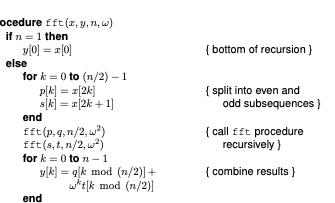
Complexity & Features
- Cost: $\log_2 n$ levels of recursion, with $\mO(n)$ operations each. Total: $\mO(n \log n)$.
- Often computed in-place.
- More reductions if $x$ is real.
- Can be written iteratively.