The Art of Numerical Analysis 🎨

Why do we need numerical methods?
From Babylonian clay tablets to Spotify.

Lecture 2-1

1. Introduction

Slides 2-3

What is Numerical Analysis?

Numerical analysis is the study of algorithms that use numerical approximation (as opposed to general symbolic manipulations) for problems of mathematical analysis.

"This does not require a very precise calculation. Sometimes the key point is to solve the problems with a (relatively) quick-and-dirty way, comparing to a full analytical solution."

1.1 Historical Context

Slides 4-5

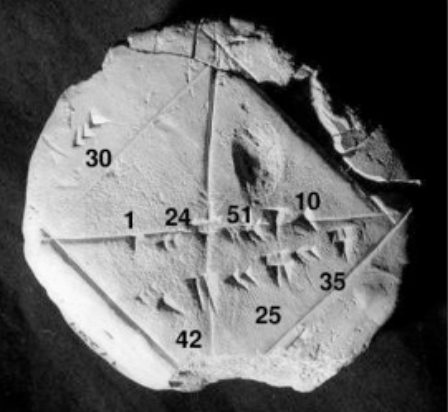
Historical Example: Babylonian Tablet

Babylonian Tablet

Dated 1800-1600 BC. Approximation of $\sqrt{2}$:

$$1 + 24/60 + 51/60^2 + 10/60^3$$

$= 1.41421296...$

Modern Context

"The real speciality of computers is repetition." Your computer can perform boring calculations millions of times. A smarter way provides quick and precise results.

2. The Art of Music 🎵

Slides 6-12

Converting audio to sheet music involves analyzing frequencies.

Generating/Loading Audio (A440 Hz)

2.1 Fourier Analysis

Slides 10-12

Fourier Transform (Spectrum)

We use the Fast Fourier Transform (FFT) to find the dominant frequencies.

Result: A sharp peak at 440 Hz is expected!

3. Errors in Computation ⚠️

Slides 24-26

The Calculator Experiment

If you pick a calculator, insert a number, and press $\sqrt{}$ many times, you reach "1". Then square it back... you might not get the original number.

Types of Errors

1. Blunders / Bugs

Typographical errors, wrong data files, human error.

2. Roundoff Errors

Floating point numbers have finite precision.

4. Floating Point Arithmetic 💻

Slides 27-30

IEEE 754 Standard

$$(-1)^{\text{sign}} \times 2^{\text{exponent}-1023} \times (1 + \sum_{i=1}^{52} b_{52-i} 2^{-i})$$

4.1 IEEE 754 Visualized

Slides 27-30 (Cont.)
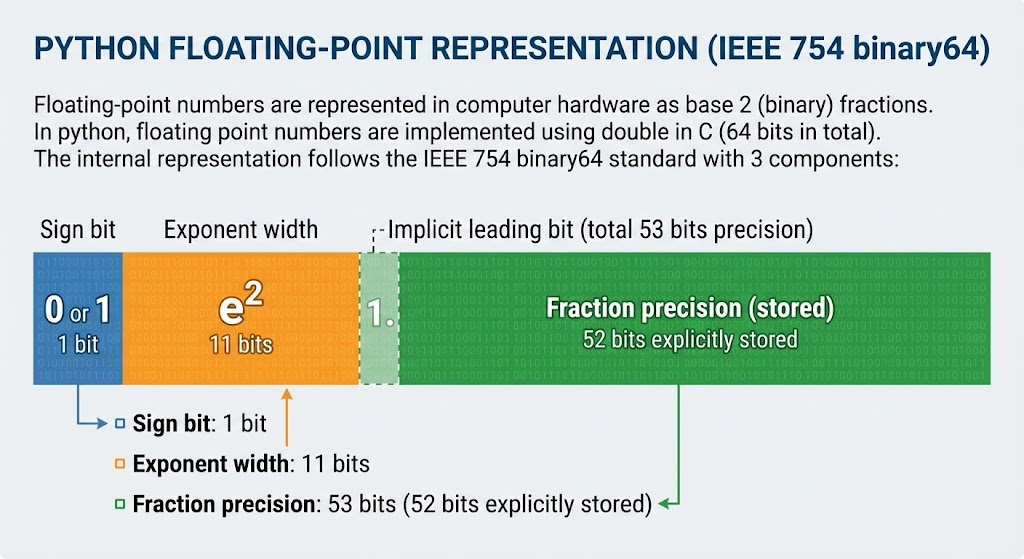
IEEE 754 Infographic

4.2 Video Reference 🎥

Video

4.3 Precision Issues

Slides 27-30 (Cont.)

"The Spoon is Not Real"

Computers cannot represent 0.1 exactly.

4.4 Lecture Video 🎥

Video

5. Calculating $\pi$ 🥧

Slides 32-37

Using polygon approximation. As the number of sides $N$ increases, precision SHOULD improve, but eventually degrades due to roundoff.

$$S' = \sqrt{2 - \sqrt{4 - S^2}} \quad \text{(Recursive formula)}$$

What goes wrong?

For very large $N$, $S$ becomes very small. $4 - S^2$ hits the limit of double precision, causing Catastrophic Cancellation.