Bisection & Newton's Method
Algorithms for finding roots of functions.
The Bisection Method
Concept
Given a bracketed root (interval $[a,b]$ where $f(a)$ and $f(b)$ have opposite signs), split the bracket in half. Select the sub-bracket that contains the root. Repeat.

Algorithm
Analysis
Interval size reduces by half each step: $\delta_n = 2^{-n} \delta_0$.
Linear Convergence: $n = \log_2(\frac{\delta_n}{\delta_0})$. To reduce error by $10^{-3}$, need $\approx 10$ steps.
Bisection Example
Solve $x - x^{1/3} - 2 = 0$. Initial bracket $[3, 4]$.
| k | a | b | $x_{mid}$ | $f(x_{mid})$ |
|---|---|---|---|---|
| 0 | 3 | 4 | - | - |
| 1 | 3 | 4 | 3.5 | -0.018 |
| 2 | 3.5 | 4 | 3.75 | 0.196 |
| 3 | 3.5 | 3.75 | 3.625 | 0.089 |
Convergence Criteria
Check Step Size ($x$)
$|x_k - x_{k-1}| < \delta_x
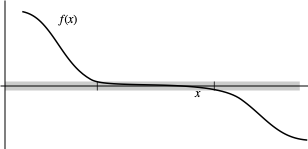
Best when $f'(x)$ is large.
Check Function Value ($f(x)$)
$|f(x_k)| < \delta_f$
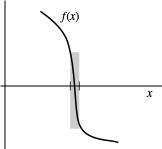
Best when $f'(x)$ is small.
Newton's Method
Use the slope $f'(x_k)$ to predict where the function crosses zero. Derived from Taylor Series.
$x_{k+1} = x_k - \frac{f(x_k)}{f'(x_k)}$

Example Comparison
Solve $x - x^{1/3} - 2 = 0$.
| k | $x_k$ | $f(x_k)$ |
|---|---|---|
| 0 | 3 | -0.442 |
| 1 | 3.5266 | 0.0045 |
| 2 | 3.5213 | $3.7 \times 10^{-7}$ |
| 3 | 3.5213 | $2.6 \times 10^{-15}$ |
Converged in 3 steps! (vs ~50 for bisection)
When Newton Fails
If $f'(x_k) \approx 0$, the next guess shoots off to infinity.

Secant Method
What if we don't know $f'(x)$? Approximate it using the last two points.
$x_{k+1} = x_k - f(x_k) \frac{x_k - x_{k-1}}{f(x_k) - f(x_{k-1})}$
Pros
- No derivative needed.
- Fast convergence ($r \approx 1.62$).
Cons
- Needs two initial guesses.
- Not guaranteed to bracket.
- Can diverge.

Summary & MATLAB's fzero
MATLAB: fzero
Hybrid method! Combines Bisection, Secant, and Inverse Quadratic Interpolation.
🧠 Final Challenge +20 XP
Which method would you choose if you need guaranteed convergence and have a valid bracket, even if it's slow?